
Why Visual and Thermal Combined Inspection Finds What Others Miss
A roof can look perfectly sound from the outside and be failing underneath. That's not a hypothetical, it's something we encounter on a regular basis. The membrane appears intact, the flashings look tidy, and a visual inspection from ground level or even from the roof surface gives no cause for concern. Then the thermal camera tells a completely different story.
Trapped moisture beneath a single-ply membrane. Delamination in a built-up felt system. A cold bridge at a parapet junction that's driving condensation into the building fabric. None of these defects are visible to the naked eye. All of them are clearly identifiable through radiometric thermal imaging. And all of them, left unaddressed, will eventually become the kind of expensive, disruptive failures that end up on someone's emergency repairs budget.
The argument for combining visual and thermal inspection isn't theoretical. It's grounded in the physics of how buildings deteriorate and the practical reality that no single inspection method sees everything.
What visual inspection does well - and where it stops
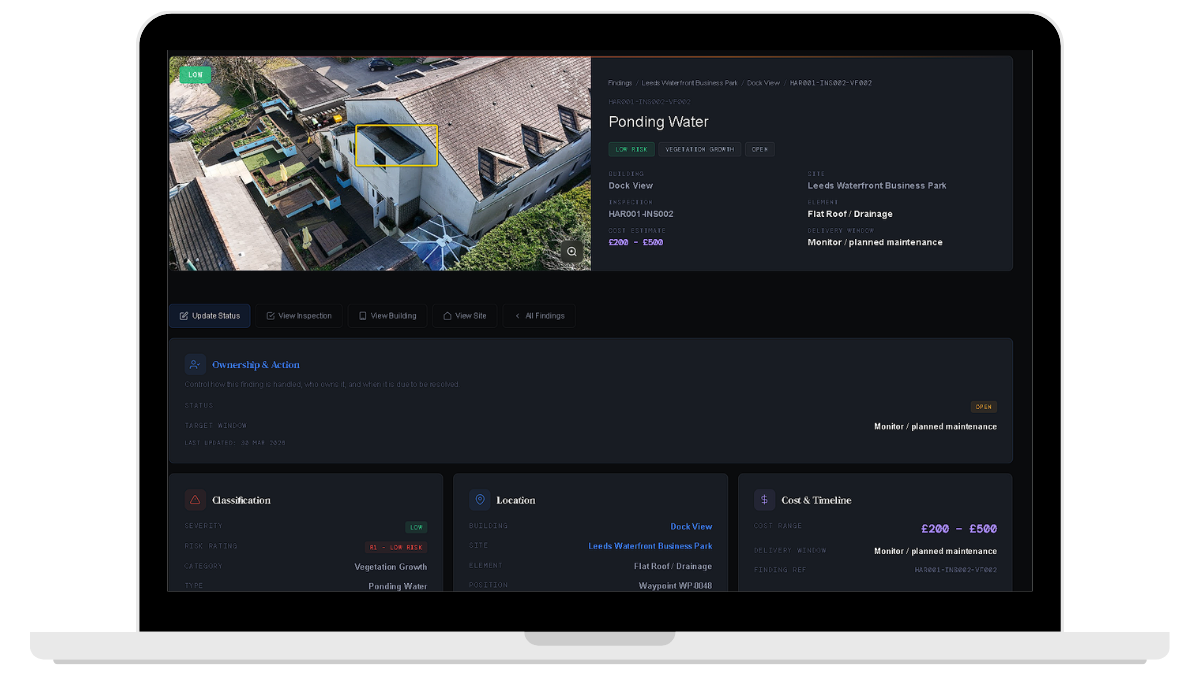
High-resolution visual inspection is the foundation of any competent building survey. Captured from a UAV at close range, it reveals surface-level defects with remarkable clarity: cracked or displaced tiles, torn membrane laps, blocked or damaged guttering, deteriorating mortar joints, corroded flashings, vegetation growth, ponding water, displaced copings, and failed sealant lines. A skilled analyst reviewing high-resolution drone imagery will identify defects that a surveyor standing on the roof might walk straight past, simply because the camera captures everything, not just what catches the eye in the moment.
But visual inspection has an inherent limitation. It can only see what's happening on the surface. A membrane that's holding water beneath it looks identical to one that's dry. A wall that's losing heat through a thermal bridge looks the same as one that's properly insulated. A flat roof with internal delamination presents no visible clue from above. These are subsurface or performance-related defects, and they sit outside the reach of even the best optical camera.
This is the gap that catches people out. A visual-only inspection can give you a false sense of security - a clean bill of health for a roof that's actually saturated, or a facade that's leaking energy at every fixing point. It's not that the visual inspection is wrong. It's that it's incomplete.
What thermal imaging adds
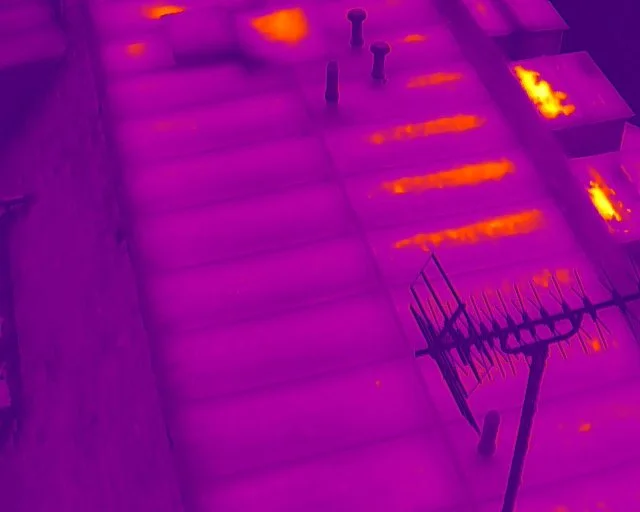
Radiometric thermal imaging measures the infrared radiation emitted by surfaces and converts it into temperature data. Every pixel in a radiometric thermal image carries an actual temperature value, not just a colour gradient. That level of precision allows an analyst to identify temperature differentials across a building's envelope, differentials that correspond to specific physical conditions.
Moisture trapped beneath a roof membrane, for instance, retains heat differently from the surrounding dry material. During the right conditions -typically a cooling period after solar gain - the wet areas radiate heat more slowly than the dry areas, creating a clear thermal signature. That signature is invisible to the eye but unmistakable on a calibrated thermal sensor.
The same principle applies to thermal bridging. Where insulation is missing, compressed, or bypassed by structural elements, heat escapes more readily, creating localised warm spots on the building's exterior (in winter) or cool spots (in summer). Radiometric thermal data quantifies these anomalies precisely, allowing you to distinguish a minor performance variation from a significant insulation failure.
Other conditions that thermal imaging reliably identifies include water ingress paths through facades, air leakage points around windows and doors, underperforming or blocked heating circuits in underfloor systems, electrical hotspots in distribution boards (when scanned externally), and failed cavity closers behind cladding systems.
None of these would appear on a visual-only survey. All of them represent genuine building performance issues that affect energy efficiency, occupant comfort, fabric longevity, or safety.
Why the combination matters more than either method alone
The real power of combined inspection isn't simply that you get two datasets instead of one. It's that each dataset contextualises the other.
Consider a flat roof where the thermal scan shows a large area of retained moisture beneath the membrane. That's valuable information, but it doesn't tell you how the water got there. The visual imagery might reveal a failed upstand detail, a cracked flashing, or a displaced lap joint nearby. Now you have both the symptom and the likely cause, which means the remediation can be targeted rather than speculative.
It works in the other direction too. Visual inspection might identify a discoloured patch on a facade that could be surface staining, biological growth, or moisture tracking. The thermal data can confirm whether there's an active moisture path behind that discolouration or whether it's cosmetic. That distinction can be the difference between a minor clean and a significant facade repair.
For roof surveys in particular, the combined approach dramatically reduces the risk of a false negative - an inspection that says "all clear" when there's actually a problem developing beneath the surface. Research published by the Building Research Establishment has consistently highlighted that moisture-related deterioration in flat roof systems is one of the most common causes of premature failure, and that early detection through thermal surveying significantly extends roof life. Our own data across hundreds of commercial and residential roof surveys supports this. Roughly one in three roofs we inspect with combined visual and thermal methods reveals a defect that would not have been identified by visual inspection alone.
The operational case
Beyond the technical argument, there's a practical one. If you're going to mobilise an inspection team - whether by drone, rope access, or any other means - it makes sense to capture as much useful data as possible in a single visit. Running a visual-only survey and then returning six months later for a thermal survey doubles the mobilisation cost, doubles the disruption, and halves the analytical value, because the two datasets weren't captured under the same conditions.
A combined UAV survey captures both datasets simultaneously. The drone carries both a high-resolution optical camera and a radiometric thermal sensor, and the entire building envelope - roof, facades, parapets, soffits, drainage - is covered in a single flight programme. The result is a paired dataset that can be cross-referenced defect by defect, location by location, giving your maintenance team or your compliance function a genuinely complete picture.
For clients managing portfolios of buildings, this efficiency compounds. Instead of commissioning separate visual and thermal surveys from different providers at different times, the entire programme runs as a single, standardised workflow. Every building is surveyed to the same specification, with the same defect categorisation, in the same reporting format. That consistency matters when you're aggregating data across a portfolio and making strategic CAPEX decisions.
How Ovrsite delivers combined inspection
At Ovrsite, combined visual and radiometric thermal capture is our standard specification, not an optional add-on. Every survey we deliver uses both sensor types, flown by CAA-registered pilots, with the data processed through our AI-assisted defect detection pipeline and reviewed by qualified analysts.
The output isn't two separate reports stapled together. It's an integrated defect register where each finding is supported by the relevant visual and thermal evidence, categorised by type and severity, and delivered through our Atlas platform for ongoing tracking and compliance use.
If you've been relying on visual-only inspection - or worse, on no regular inspection at all - there's a significant layer of building intelligence you're missing. Combined visual and thermal survey is the fastest, most cost-effective way to close that gap.
Contact Ovrsite to find out what a combined inspection programme would look like for your portfolio.
Ovrsite provides UAV-first building inspection with combined high-resolution visual and radiometric thermal capture, AI-assisted defect detection, and structured intelligence through the Atlas platform.