
BAC Readiness: What Evidence Does the Assessor Actually Need?
There's a question circulating in estates teams, housing associations, and FM companies across England right now, and it tends to come with a note of quiet anxiety: what exactly does the Building Assessment Certificate assessor want to see?
It's a reasonable question. The Building Safety Regulator has set out the broad framework - you must demonstrate that you're managing building safety risks effectively - but the specifics of what "good" looks like in an assessment are still being understood by the sector. And the stakes are considerable. Without a BAC, you cannot legally occupy a higher-risk building. There's no grace period for incomplete evidence.
Having worked with duty holders preparing for BAC applications across residential towers and PBSA schemes, we've seen what assessors are looking for - and, more usefully, where the gaps tend to appear.
The BAC isn't a tick-box exercise
The first thing to understand is that the BAC assessment isn't structured like a traditional compliance audit. There's no fixed checklist of 47 items where you tick yes or no and get a pass mark. The regime is outcomes-based. The assessor's job is to satisfy themselves that you - as the principal accountable person or accountable person, understand the safety risks in your building and are managing them competently.
That distinction matters because it changes the nature of the evidence required. It's not enough to show that you commissioned a fire risk assessment in 2023. The assessor will want to understand what you did with the findings. Were actions raised? Were they completed? Is there a record of that completion? Has the situation been re-assessed since?
The same logic applies to the building's physical condition. A structural survey from five years ago might demonstrate that you once knew the state of the building, but it doesn't demonstrate that you know the state of the building now. Currency of evidence is critical.
The four pillars of BAC evidence
While the BSR hasn't published a rigid evidence template, the assessment broadly covers four areas. Think of them as the pillars your evidence base needs to stand on.
Structural and fabric condition.
The assessor needs to see that you have a current, comprehensive understanding of the building's physical condition, particularly the external envelope. Roof coverings, cladding systems, balconies, windows, external drainage, compartmentation integrity, all of it. This isn't about having a single condition survey on file. It's about demonstrating that you have ongoing visibility of the building's fabric and that you're tracking changes over time.
This is where many duty holders discover their first major gap. Traditional inspection regimes often skip the roof entirely, or cover it with a cursory visual check from an adjacent structure. For the BAC, that won't be sufficient. The assessor will expect evidence that covers the full envelope, including areas that are only accessible at height.
Fire safety management.
This encompasses your fire risk assessment, fire safety strategy, evacuation procedures (including PEEPs for vulnerable residents), fire door inspection records, compartmentation surveys, and the management of any interim measures. The evidence needs to show a living system, not a static document. Are your fire doors on a scheduled inspection cycle? Is there a log? When defects are found, what's the remediation timeline?
Resident engagement.
The BSA 2022 places significant emphasis on resident engagement, and the BAC assessment reflects this. You'll need to demonstrate that residents have been consulted on safety matters, that they have access to relevant safety information, and that there's a functioning mechanism for them to raise concerns. This isn't a token newsletter. The assessor will look for evidence of meaningful, two-way communication.
Mandatory occurrence reporting.
If a safety occurrence has taken place - a fire, structural movement, water ingress affecting safety systems - the assessor will check that it was reported through the mandatory occurrence reporting (MOR) system and that your response was documented. Missing MOR submissions are a significant red flag in any BAC assessment.
Where the evidence gaps typically sit
In our experience, the evidence gaps that cause the most difficulty at BAC stage aren't the obvious ones. Most duty holders have a fire risk assessment. Most have some form of maintenance records. The problems tend to be subtler.
No structured defect register.
Many buildings have been inspected at various points, but the findings exist as standalone PDF reports, each in a slightly different format, with no consistent defect categorisation or tracking. The assessor doesn't want to read through six separate reports to piece together what's going on with the roof. They want a single, structured view of known defects, their severity, their status, and the planned response.
Incomplete envelope coverage.
If your inspection records cover the ground-level facades but not the roof, parapets, or upper-level cladding panels, that's a gap. The BSR's expectation is that you understand the condition of the entire building envelope, not just the parts that are easy to see. UAV-based inspection exists precisely to close this gap without the cost and disruption of scaffolding or rope access.
Static data with no refresh cycle.
A thorough inspection from 2021 is useful context, but it doesn't satisfy the golden thread requirement for current, maintained building data. If you can't show when the building was last inspected, what changed since the previous inspection, and when the next inspection is scheduled, your evidence base looks reactive rather than managed.
No link between findings and actions.
Evidence of inspection is only half the story. The assessor will trace the line from finding to action to completion. If your last condition survey flagged deteriorating flashings and there's no record of remediation or a documented decision to defer with rationale, that's a problem. The evidence chain needs to be complete.
What good BAC evidence looks like in practice
The duty holders who are best positioned for BAC assessment tend to share a few characteristics. They have a single source of truth for building condition data, not scattered across email attachments and shared drives. Their defect registers are structured, categorised by severity, and updated on a defined cycle. Their inspection coverage extends to the full building envelope, including the roof and upper facades. And they can demonstrate a clear link between inspection findings, risk assessments, and remedial actions.
None of this requires exotic technology. But it does require a deliberate approach to evidence generation and management - one that treats inspection data as a compliance asset rather than a maintenance input.
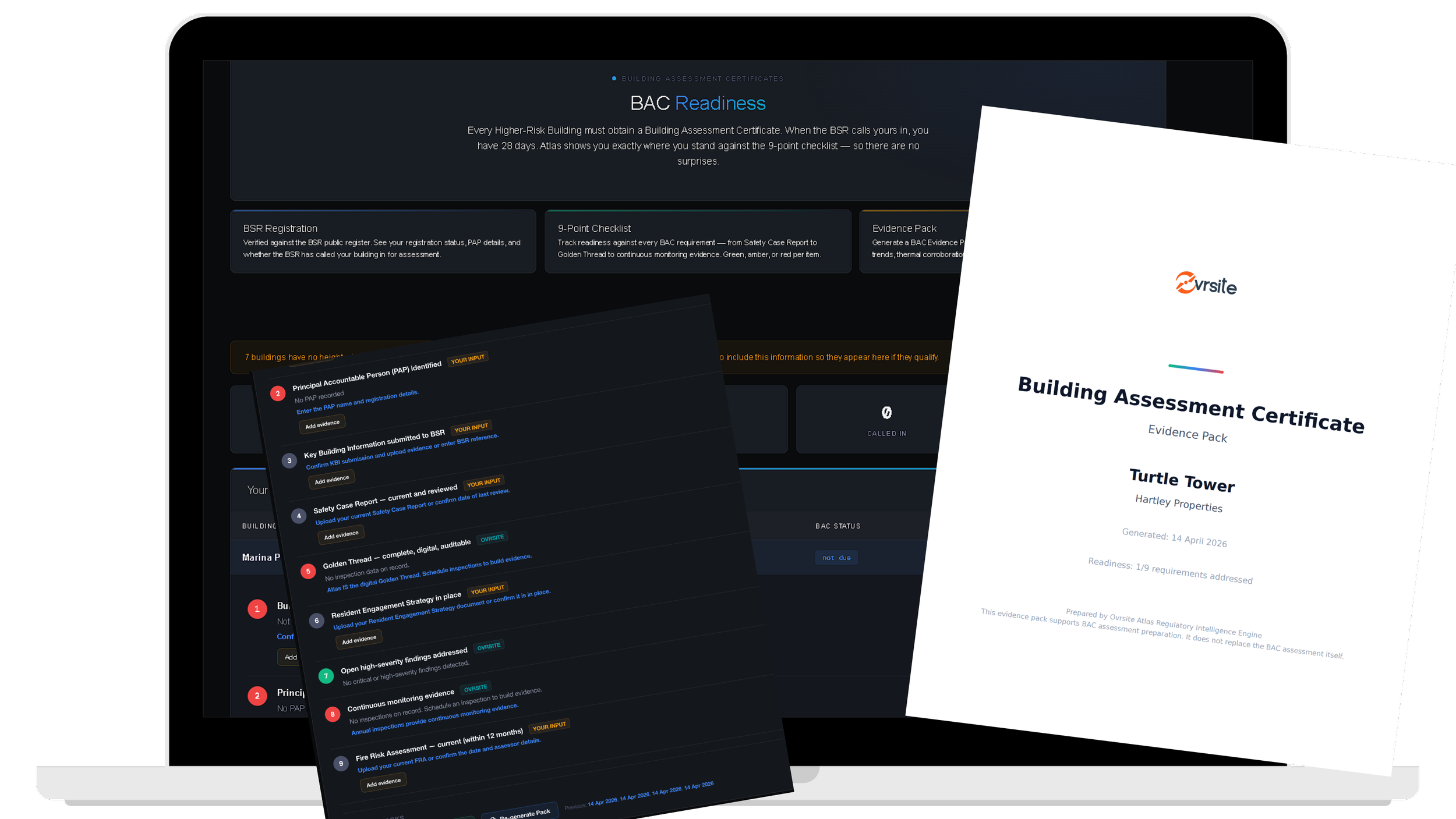
Ovrsite Atlas - Built to remove the heavy lifting from BAC reainess
How Ovrsite supports BAC readiness
This is the problem Ovrsite was built to solve. Our inspection model captures high-resolution visual and radiometric thermal imagery across the full building envelope using CAA-registered UAV pilots - covering roofs, facades, parapets, cladding, drainage, and balconies in a single visit. Every defect identified is logged in a structured register with categorisation, severity grading, and geotagged location data.
Through Atlas, our building intelligence platform, that data is maintained over time - giving you the current, auditable, refreshable evidence base that BAC assessors expect. When the assessor asks what you know about the condition of the roof membrane, you have an answer. When they ask when it was last inspected and what's changed, you have that too.
If you're preparing for a BAC application and you're not confident your evidence base is complete, a conversation now is worth far more than a gap discovered at assessment.
Talk to Ovrsite about getting your buildings BAC-ready - before the assessor arrives.
Ovrsite delivers UAV-first building inspection, structured defect intelligence, and compliance-aligned reporting for duty holders managing higher-risk buildings under the Building Safety Act 2022.